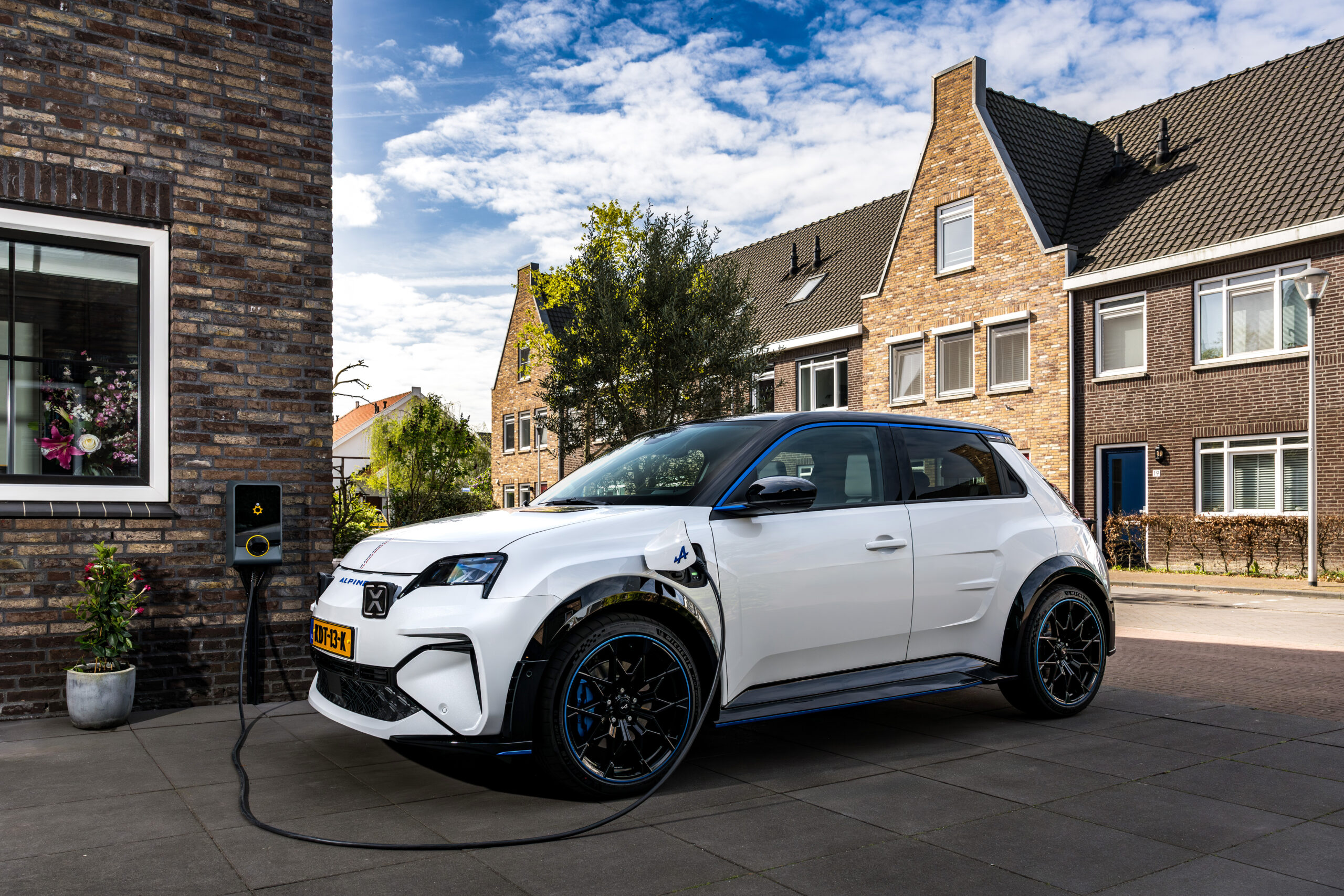
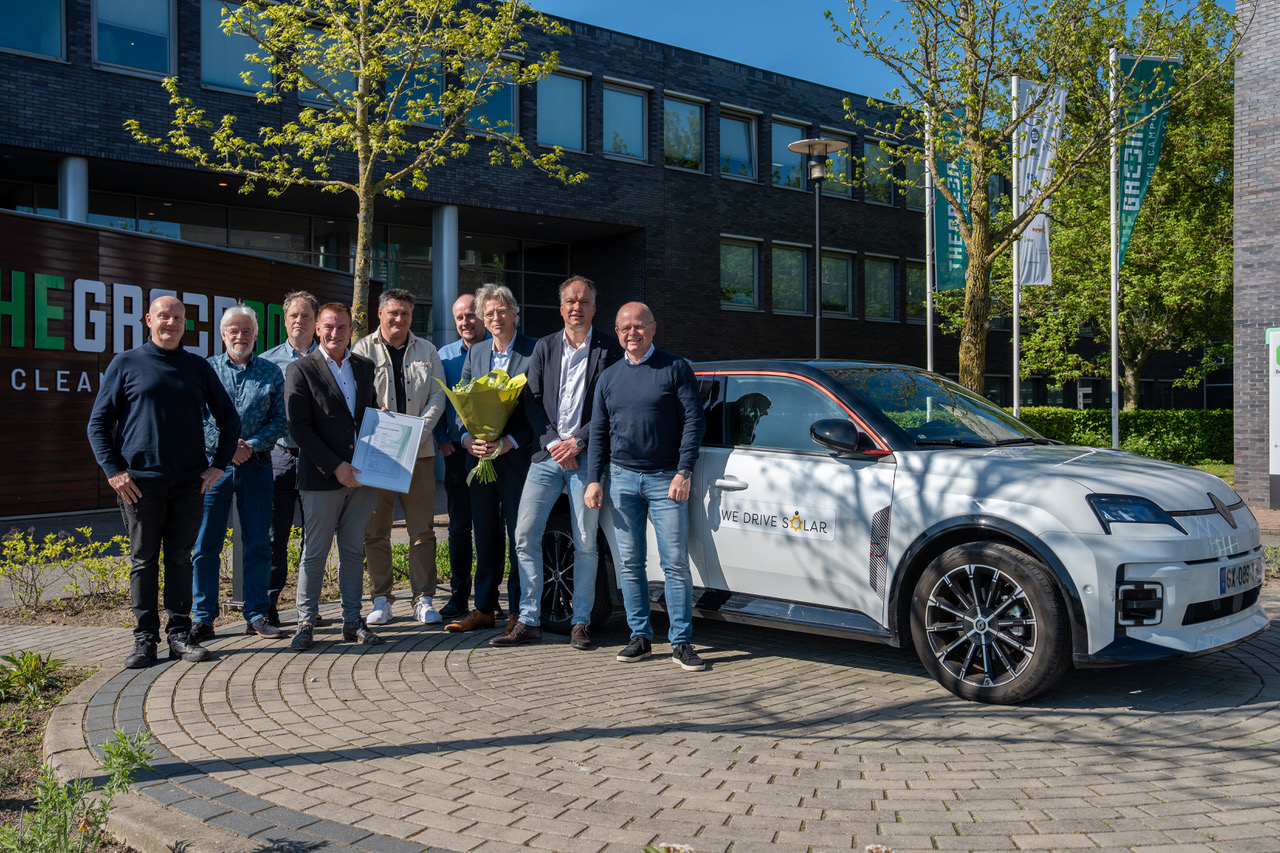
- IN PARTNERSHIP WITH WE DRIVE SOLAR, RENAULT GROUP NETHERLANDS INTRODUCES A ‘VEHICLE-TO-GRID’ (V2G) SERVICE FOR PRIVATE CUSTOMERS IN THE NETHERLANDS: POWER V2G
- FOLLOWING THE INTRODUCTION OF V2G AC CHARGING IN FRANCE BY RENAULT GROUP, THIS TECHNOLOGY IS NOW AVAILABLE TO PRIVATE CUSTOMERS OF RENAULT GROUP ELECTRIC MODELS IN THE NETHERLANDS
- POWER V2G ENABLES CONSUMERS TO REDUCE THEIR TOTAL ELECTRICITY BILLS AND CONTRIBUTE TO THE ENERGY TRANSITION BY BIDIRECTIONAL CHARGING WITH THEIR RENAULT GROUP ELECTRIC VEHICLE
Schiphol-Rijk, May 19 2026 – Against a backdrop of volatile energy markets, persistently high electricity price fluctuations and mounting grid congestion across the Netherlands, Renault Group is taking a next step in smart energy integration. In partnership with We Drive Solar, the company is introducing a Vehicle-to-Grid (V2G) service for private customers – a practical contribution to easing pressure on the electricity grid while helping customers better manage their energy costs.
The Netherlands has the highest density of solar panels in Europe. As a result, there are increasing peaks of low-cost renewable electricity available. The rapid growth of renewable energy – particularly solar – continues to create significant imbalances between supply and demand. At times of surplus, electricity prices drop sharply, while peak moments increasingly strain the grid, leading to congestion issues in many regions. Solutions to these challenges require a combination of measures, from grid reinforcement to smarter energy use.
Vehicle-to-Grid technology is one of these measures. By enabling electric vehicles to not only charge but also temporarily return electricity to the grid, V2G helps to balance supply and demand more effectively. In doing so, it supports grid stability alongside other solutions, while allowing EV drivers to benefit from dynamic energy pricing. Vehicles are charged when there is an abundance of renewable energy on the grid and electricity prices are lower, allowing consumers to achieve significant savings. Discharging to the grid happens when demand and electricity prices are high, at which point the cars help to relieve the strain on the grid.
Renault Group is a pioneer in electric mobility and has been working on V2G since 2016. Following the successful launch of the V2G car-sharing service in Utrecht and Eindhoven in 2025, Renault Group and We Drive Solar are now the first to make this service available to private customers.
To benefit from the V2G service, customers require the following components:
- An electric vehicle from Renault or Alpine equipped with an onboard charger suitable for V2G. Initially, this includes the Renault 5 E-Tech electric, Renault 4 E-Tech electric, Renault Twingo E-Tech electric (soon) and Alpine A290. Customers can check online and with their dealer whether their model is compatible with V2G.
- The V2G bidirectional charging point Solar Life from We Drive Solar**.
- A corresponding dynamic energy contract from V2G-compatible energy suppliers to start with Hegg Energy including the associated mobile app.
- In addition, the home must be located in the Netherlands, be suitable for the installation of a home charger, and be equipped with a fixed internet connection, a three-phase electricity connection, and a smart meter.
* National Charging Survey 2023 (ElaadNL, VER, RVO).
** This charging point can also be used to charge electric or plug-in hybrid vehicles that are not V2G-compatible.
Contents
Vehicle-to-Grid: the Renault Group solution.. 3
Renault Group: the first car manufacturer with V2G in the Netherlands. 3
The energy supplier: Hegg Energy / EnergyZero.. 3
How it works for the customer. 5
Additional benefits for the customer. 6
Vehicle-to-grid: the technology.. 6
Results after one year of V2G in the real world.. 7

Vehicle-to-Grid: the Renault Group solution
Renault Group: the first car manufacturer with V2G in the Netherlands
Renault Group is the first car manufacturer to make Vehicle-to-Grid (V2G) technology available to consumers in the Netherlands with Power V2G. A successful large-scale deployment of V2G requires a harmonised approach across the entire energy system, in which vehicles, charging infrastructure, energy suppliers and grid operators work together. Renault Group and We Drive Solar can now offer a complete V2G ecosystem to both consumers and businesses, following more than ten years of development and testing.
We Drive Solar is a leading provider of smart charging solutions designed to support a fully sustainable energy system. With more than ten years of dedicated experience in bidirectional charging technology, We Drive Solar supplies advanced bidirectional charging stations suitable for energy balancing and for solar-powered charging and discharging of electric vehicles.
The partnership between Renault Group and We Drive Solar in this field dates back to 2016 and has resulted in two leading V2G solutions: the Solar City charging station for public charging infrastructure, used in cities such as Utrecht and Eindhoven, and the Solar Life charging point for private use. With the Solar Life charging point, consumers can charge bidirectionally at home.
For Power V2G to operate successfully, three components must work seamlessly together: the vehicle, the bidirectional charging point and the dynamic energy contract. At present, selected energy suppliers offer contracts specifically for V2G: to start with Hegg Energy.
For customers, three main requirements must be met in order to benefit from Vehicle-to-Grid: the right vehicle, combined with the Solar Life charging point from We Drive Solar and a compatible dynamic energy contract.
All electric models from Renault Group brands (Renault and Alpine) equipped with a V2G-compatible onboard charger can feed electricity back into the grid. At present, these include the Renault 5 E-Tech electric, Renault 4 E-Tech electric and Alpine A290.
The vehicle battery is designed for both charging and discharging and carries the same warranty as all other Renault EV batteries (8 years / 160,000 km). The V2G system preserves battery longevity. The software monitors the battery status and ensures that only between 20% and 80% of the battery capacity can be returned to the electricity grid. Power V2G operates at low power levels and has less impact than fast charging or driving.
Customers can verify whether their vehicle is equipped with the required hardware to use V2G via the VIN checker on Renault.nl or their local dealer. To ensure that the Renault or Alpine model concerned is compatible, We Drive Solar also checks the vehicle’s VIN number for V2G suitability before the installation process begins.
During the course of 2026, Power V2G is expected to become available for additional Renault Group electric models equipped with onboard chargers suitable for V2G technology.
The Solar Life charging point from We Drive Solar facilitates communication between the vehicle and the electricity grid. This charging point, produced in the Netherlands, enables both charging and the feeding of electricity back into the grid with compatible Renault Group electric vehicles.
The maximum charging speed of the Solar Life charging point is 22 kW, while discharging is possible at up to 11 kW. We Drive Solar controls the link between the vehicle and the energy network, ensuring the highest possible V2G returns while preventing overloading of the home electricity connection.
Other electric and plug-in hybrid vehicles without V2G-compatible hardware can also be charged using this charging point.
The Solar Life charging point has been selected by Renault Group as the V2G charging solution for the Netherlands and is currently the only charging point in the country certified for feeding electricity from electric vehicles back into the public electricity grid.
The installation costs of the charging point depend on the customer’s specific situation (for example the type of electrical connection, the distance to the meter cupboard, excavation work and mounting of the charging point). In addition, a charging-point subscription is required for V2G. This subscription enables V2G control, business settlement and the registration of Emission Reduction Units (ERU’s).
For the most up-to-date pricing information, please visit the We Drive Solar V2G webpage.

After the vehicle and the charging point, the specific dynamic energy contract is the third required component in the Renault Group Power V2G ecosystem. A dynamic energy contract is necessary in order to benefit from fluctuations in supply and demand on the electricity grid.
When large amounts of solar or wind energy are expected, there is a surplus of green electricity and prices drop sharply. At those times, excess renewable energy can be stored cheaply in the battery of the electric vehicle. Conversely, when demand for green electricity exceeds supply, energy prices rise. At that point, feeding electricity back into the grid – either renewable energy from the grid or solar energy generated at home and stored in the vehicle battery – becomes profitable for both the electricity system and the customer’s wallet.
The energy suppliers are compatible with the smart charging and discharging control provided by We Drive Solar. As a result, the process runs entirely automatically. The only action required from the customer is to set their preferred charging schedule and minimum battery level via the energy supplier’s app, ensuring the vehicle battery is always sufficiently charged when they depart. The software then determines the optimal moments for charging and discharging.
Hegg Energy currently offers the lowest purchasing fee in the Netherlands specifically for V2G customers. With this low purchasing fee, V2G becomes even more attractive.
In the future, the V2G service will become compatible with additional energy suppliers selected by We Drive Solar.
The Power V2G service can be activated for one vehicle per household. The household must be located in the Netherlands and connected to the public electricity grid via one of the Dutch regional grid operators. In addition, the property must have a three-phase connection, a fixed internet connection, a smart meter, and the capability to install a charging point on the premises.
When purchasing a Renault Group electric vehicle, the dealer collects the customer’s details if they are interested in the Power V2G service and shares them with We Drive Solar. Customers who have already purchased their vehicle can also request and activate V2G online.
Experts from We Drive Solar then guide customers through ordering the Solar Life charging point, its installation, and registering for the corresponding dynamic energy contract. In addition to the criteria outlined above, We Drive Solar conducts suitability checks to ensure that the customer qualifies for the V2G service. The process is as follows:
- Purchase and installation of the Solar Life charging point from We Drive Solar
- Signing a dynamic energy contract via We Drive Solar. Customers receive a confirmation email with the details of the new energy contract
- The selected energy supplier manages the switch from the customer’s current energy provider
- Once the Solar Life charging point is installed and the dynamic energy contract is active, the customer’s vehicle is activated for Power V2G and appears in the energy supplier’s app
- The customer can start feeding electricity back into the grid
Additional benefits for the customer
Thanks to a MID-certified meter in the Solar Life, business settlement is possible, and customers can earn revenue through the creation of ERU certificates. A MID meter is a certified kWh meter integrated into the charging point. ERU stands for Emission Reduction Units. These certificates document the amount of CO₂ saved by using renewable energy for transport. The system is operated by the Dutch Emissions Authority (NEa) and commenced on 1 January 2026.
The aim is to promote sustainable transport. The certificates are funded by oil companies selling fossil fuels; for each litre of fuel sold, they must purchase ERUs. This revenue goes directly to the electric vehicle owner who charges at home.
Vehicle-to-grid: the technology
The transition to electric mobility is key to the energy transition, but charging EVs can create peaks on the electricity grid. Current charging peaks occur on weekday evenings when drivers charge their vehicles after work, coinciding with high household electricity demand for cooking and other activities. Charging a large EV can place the same load on the grid as several households simultaneously. As the number of EVs increases, grid load grows.
The intermittent nature of renewable energy from solar and wind also creates challenges for the electricity network. Grid operators often need to reinforce networks, leading to significant societal costs. This is also one of the reasons why the Dutch government will phase out the net metering scheme from 1 January 2027. From that date, self-generated electricity can no longer be offset against consumption. While feeding electricity back into the grid will still be possible, current feed-in tariffs offered by energy suppliers often make it uneconomical. Smart feed-in is therefore essential to maintain the financial viability of solar power. Vehicle-to-Grid (V2G) technology provides the solution. V2G allows electric vehicles not only to draw electricity from the grid or their own solar panels but also to feed electricity back during peak hours — turning vehicles into mobile energy sources. This feed-in supports, rather than burdens, the electricity grid. Over time, each EV can contribute to stabilising the grid and accelerating the transition to a smarter, more sustainable energy system.
Other forms of bidirectional vehicle energy use include:
- Vehicle-to-Load (V2L): The EV can power 230V devices (e.g., electric bikes) directly. This is possible with all current Renault Group electric models.
- Vehicle-to-Home (V2H): The EV supplies electricity directly to a home, reducing costs or providing backup during outages, without feeding energy back to the grid.
- Vehicle-to-Building (V2B): Multiple EVs supply power simultaneously to a building, office, or residential complex to reduce peak loads.
Currently, Renault Group offers V2G and V2L on its vehicles.
Results after one year of V2G in the real world
Since late 2024, Renault Group Netherlands, We Drive Solar, and The Sharing Group have been rolling out V2G in the Netherlands. This collaborative approach has led to several successful projects, with Utrecht energized marking a spectacular launch. The project initiated V2G in public space, with a fleet of Renault 5 E-Tech electric car-sharing vehicles from MyWheels feeding electricity back into the city. The V2G car-sharing service is now also operational in Eindhoven, with further city rollouts planned. Early results demonstrate the technology’s strong potential.

Grid operator Stedin reported positive outcomes after the first eight months of V2G charging with car-sharing vehicles in Utrecht. With 50 vehicles at launch, evening peak congestion was reduced by up to 300 kW, and over 100,000 kWh was fed back into the grid. Eindhoven was the second Dutch city to launch a V2G car-sharing service. Current results with the first 50 cars in Utrecht include:
- 100,000 kWh fed back to the grid in eight months
- 2,000 kWh per vehicle
- 200 V2G hours per vehicle
- Renault 5 E-Tech electric is most popular shared car in Utrecht
Since May, 250 Renault 5 E-Tech electric and 80 Renault 4 E-Tech electric car-sharing vehicles are active with V2G in Utrecht and Eindhoven (expansion to 500 cars planned in 2026).
Further expansion of the V2G car-sharing service
In Eindhoven, the V2G car-sharing service results from collaboration between Renault Group, MyWheels, We Drive Solar, the Eindhoven municipality, and grid operator Enexis. In Eindhoven, 30 Renault 5 E-Tech electric currently help to relieve grid congestion. It demonstrates the public interest in this technology. Following Utrecht and Eindhoven, V2G car-sharing services are being planned for Rotterdam and Amsterdam this year.
Before the official launch of the Power V2G service for private users, the service was extensively tested by a group of early adopters to ensure seamless integration between vehicle, charging point, and energy supplier.
The first commercial V2G offering for private EV users was launched in France in 2024, establishing Renault Group as a pioneer in this technology. The Netherlands followed in 2025 with a large-scale V2G implementation combined with a car-sharing fleet, and in 2026 the service is now available to private users. Renault Group is also working on V2G rollout in Germany and the United Kingdom. There is strong European interest in the technology, with the Netherlands currently playing a leading role.
About Renault Group
Renault Group is at the forefront of a mobility that is reinventing itself. The Group relies on the complementarity of its three automotive brands – Renault, Dacia, Alpine – and its financial captive – Mobilize Financial Services – to offer sustainable and innovative mobility solutions to its customers. Established in more than 100 countries, Renault Group sold 2.337 million vehicles in 2025. It employs more than 100,000 people who embody its Purpose every day, so that mobility brings people closer.
Ready to pursue challenges both on the road and in competition, the Group is committed to an ambitious and value-generating transformation focused on the development of new technologies and services, and a new range of even more competitive, balanced, and electrified vehicles. In line with environmental challenges, Renault Group’s ambition is to achieve carbon neutrality in Europe by 2040 and worldwide by 2050.
For more information: www.renaultgroup.com/en
About We Drive Solar
We Drive Solar is a leading provider of smart charging infrastructure supporting a fully renewable energy system. Active for ten years in bidirectional solutions, the company supplies AC bidirectional chargers to international clients. Working with manufacturers such as Renault, and it’s partners ElaadNL, Stedin, The Sharing group, LomboXnet and Last Mile Solutions, We Drive Solar has achieved several world firsts in bidirectional charging.
For more details see: v2g.wedrivesolar.nl